Dog Osteopath in Ontario: Mobility, Pain Relief and Recovery Support
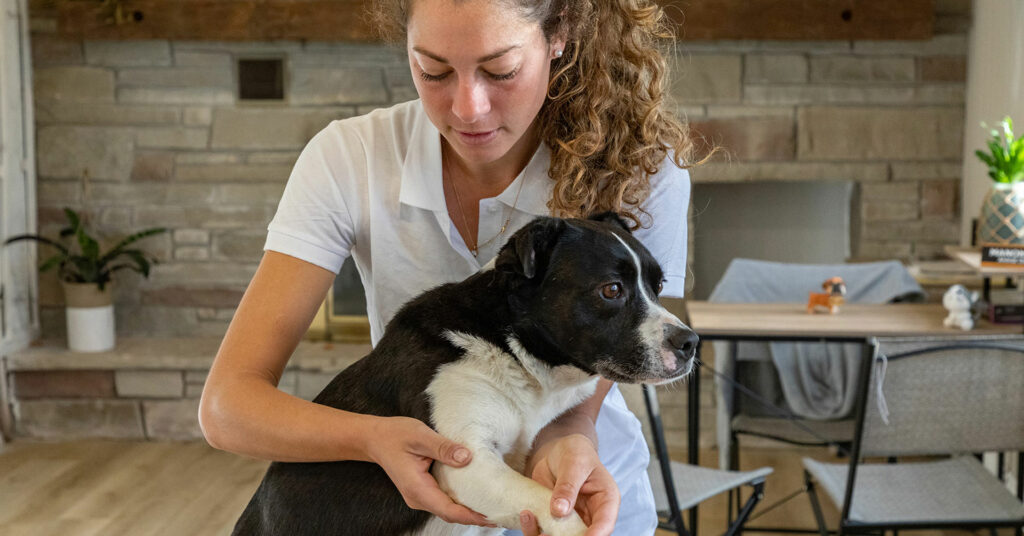
Looking for a dog osteopath near you in Ontario? Manon Turbé treats dogs at her clinic at 695 Middletown Road in Waterdown, and visits homes within about one hour’s drive, from Hamilton and Burlington to Guelph, Kitchener and Toronto. Sessions use gentle, hands-on techniques to help dogs move more freely.
Think of the twelve-year-old Labrador who needs three attempts to get up in the morning. The agility dog that suddenly knocks the bar. The young dog getting back on its feet after cruciate surgery. These are typical reasons owners contact a dog osteopath.
This page explains what a dog osteopath does, which signs are worth acting on, what happens during a session and how osteopathy fits with your vet’s care. A session costs 90.40 CAD, HST included.
What is dog osteopathy?
Dog osteopathy, also called canine osteopathy or osteopathy for dogs, is a manual therapy that looks at the body as a whole. It focuses on how a dog’s joints, spine, muscles and connective tissue move together. A dog osteopath uses gentle, non-invasive techniques, such as joint mobilisation and soft tissue work, to ease tension and help restore comfortable movement. Owners most often seek it for stiffness, recovery after surgery, age-related loss of mobility and the strain of sport or work. It does not replace veterinary diagnosis or treatment: it works alongside your vet.
What does a dog osteopath do?
A dog osteopath assesses how your dog stands, walks and moves, then uses gentle hands-on techniques to ease restricted joints and tense muscles, so your dog can move with more comfort in daily life.
During the assessment, I look at four things. Posture: does your dog shift its weight onto the front legs? Gait: is one hind leg taking a shorter step? Joint mobility: does the hip or shoulder move through its full range? Muscle tension: are the muscles along the spine tight on one side?
The treatment itself is quiet and slow. I mobilise joints within their natural range, release tight soft tissue and use gentle stretches. The pressure is adapted to each dog: a 3 kg Chihuahua and a 40 kg German Shepherd are not handled the same way.
What I do not do matters just as much. I do not diagnose disease, prescribe medication or take X-rays. If something I feel suggests a problem that needs medical attention, I tell you and refer you to your vet. To learn more, read how canine osteopathy can help your dog.
When should your dog see an osteopath?
Book an osteopathy session when your dog is stiff after rest, limps on and off, hesitates to jump or climb stairs, or is recovering from surgery, once your vet has ruled out anything that needs medical treatment.
Dogs rarely complain. They adapt instead, and owners notice the change weeks later: the dog that no longer jumps into the car, or that sits with one hind leg stretched out to the side. The table below links common signs to a sensible first step.
What you notice
What it can point to
First step
Stiffness when getting up, especially in the morning
Joint discomfort, possible arthritis
Vet if it is new; osteopathy alongside
Limping that comes and goes
Muscle tension or a joint problem
Vet first, to rule out an injury
Refusing to jump into the car or onto the couch
Back or hip discomfort
Vet, then osteopath
Sudden sensitivity when you stroke the back
A sore area
Vet if the pain seems sharp
Uneven stride in a sporting dog
Compensation or overload
Osteopath; vet if it persists
Recovery after surgery
Compensations after weeks of restricted movement
With your vet’s or surgeon’s agreement
You do not have to wait for a problem. For a healthy adult dog, two to four sessions a year are usually enough for prevention.
How osteopathy helps stiff, senior, sporting and post-surgery dogs
Osteopathy for dogs can help stiff, senior, sporting and post-surgery dogs move more comfortably, by easing the tension and compensations that build up around a painful or unused area. It complements veterinary care; it does not replace it.
Stiffness and uneven movement
A stiff dog often protects one area and overloads another. A dog that spares a sore hip, for example, pushes more weight onto its front legs, and the shoulders tighten in turn. Treatment aims to address areas of tension associated with compensatory movement.
Recovery after surgery
After cruciate ligament surgery or a fracture repair, a dog spends weeks moving less, or moving unevenly. Osteopathy can support the return to normal movement, always with your vet’s or surgeon’s agreement and in step with the rehabilitation plan. Find out when dog rehabilitation is needed after surgery.
Senior dogs
Older dogs lose muscle and flexibility, and many live with arthritis diagnosed by their vet. Gentle sessions aim to keep them comfortable in everyday moves: getting up, climbing two steps into the house, turning around in their bed. I adapt the pace, the pressure and the position to each dog.
Sporting and working dogs
Agility, flyball, canicross and herding put repeated strain on the same joints. Sessions can be used to monitor movement and comfort in sporting dogs, alongside veterinary care. Read more about osteopathy for sporting and working dogs.
A word of honesty: scientific studies on physical therapies in dogs are still few. A 2022 review of physiotherapy for canine osteoarthritis found that evidence of clinical efficacy remains very limited, and that most protocols are adapted from human care. That is why I focus on what we can both observe: how your dog moves before the session, and how it moves in the days after.
What happens during a dog osteopathy session?
A dog osteopathy session follows five steps: a conversation with you, an observation of your dog moving, a gentle hands-on examination, the treatment itself, and aftercare advice with a follow-up plan.
- Owner interview : We talk about your dog’s history, symptoms, past surgeries and your vet’s findings.
- Observation : I watch your dog stand, walk and turn to assess posture and gait.
- Palpation and mobility tests : I gently check joints, spine and muscles to find areas of tension or restriction.
- Gentle manual treatment : I use soft, non-invasive techniques adapted to your dog’s age and comfort.
- Aftercare and follow-up : I give simple aftercare advice and suggest a follow-up date or a vet visit if needed.
Please bring your dog’s recent vet reports, X-ray results or surgery notes if you have them. They help me understand what has already been diagnosed. Before you leave, I tell you how much activity to allow in the following days. First visit? See what to expect from a first osteopathic treatment.
Do you need your vet before seeing a dog osteopath?
Your vet diagnoses; the osteopath supports. A vet check comes first whenever your dog shows new or severe symptoms, so that any condition needing medical care is treated before osteopathy begins.
In Ontario, the College of Veterinarians of Ontario recognised in 2021 that many non-veterinarians provide these therapies, and it strongly encourages vets and other animal care providers to work together. That is how I work: I read your vet’s findings, and I tell you when your dog needs to go back to them.
See your vet first, before any osteopathy session, if your dog shows:
- sudden, severe pain or crying out when touched
- sudden weakness or dragging of the legs
- fever, vomiting or loss of appetite
- an open wound or swelling
- a recent fall, accident or fight
Training matters too. In France, non-veterinary animal osteopaths must pass an exam set by the national veterinary council to be listed on its register. Manon Turbé’s registration number is 0A 940.
Where can you find a dog osteopath near you in Ontario?
Manon Turbé sees dogs at her clinic at 695 Middletown Road in Waterdown, and visits homes within about one hour’s drive, including Hamilton, Burlington, Milton, Guelph, Cambridge, Kitchener, Brampton and Toronto.
Type of visit
Where
Good to know
Clinic
Hamilton, Burlington, Milton, Campbellville, Puslinch, Guelph, Cambridge, Kitchener, Brampton, Toronto
Travel costs added
Rounds
Other towns across Ontario
A minimum number of animals is required
Partner practitioner
Muskoka, Parry Sound, Nipissing, Sudbury, Algoma, Renfrew County, Ottawa
Contact Breanna Pearce directly
Recent rounds have included Toronto, Oshawa and Cobourg, Burlington, Puslinch and Guelph, and Stevensville in the Niagara region. If you are searching for an osteopath for dogs near you outside these towns, check the upcoming trips to see when I am next in your area.
How much does a dog osteopath cost in Ontario?
A dog osteopathy session with Manon Turbé costs 90.40 CAD, HST included, whether at the Waterdown clinic or at your home. Travel costs are added for home visits, depending on the distance.
If you have several animals to follow, for example as a breeder or a kennel, ask for a preferential rate. Animal protection associations and shelters pay half price. To book, fill in the form with your dog’s age, the reason for the visit and your town, and I will reply with a date. Book a session
How do I find a dog osteopath near me in Ontario?
Start with the practitioner’s location and travel area. Manon Turbé runs a clinic at 695 Middletown Road, Waterdown, and visits dogs within about one hour’s drive, including Hamilton, Burlington, Milton, Guelph, Cambridge, Kitchener, Brampton and Toronto. Longer trips across Ontario are organised in rounds.
Does my dog need a vet referral before seeing an osteopath?
No referral is legally required in most cases. The College of Veterinarians of Ontario states that non-conventional therapies given by non-veterinarians are generally not the practice of veterinary medicine. A vet check is still strongly advised first, so any condition needing medical care is diagnosed before osteopathy begins.
How much does a dog osteopathy session cost?
A dog osteopathy session with Manon Turbé costs 90.40 CAD, HST included. Travel costs are added for home visits, depending on distance. Owners with several animals to follow can ask for a preferential rate, and animal protection associations and shelters pay half price.
How often should my dog see an osteopath?
Follow-up frequency depends on the dog’s condition, activity and response, and is discussed individually. Senior dogs, sporting or working dogs and dogs recovering from surgery may need closer follow-up at first. The osteopath adjusts the schedule after each session, based on how your dog responds.
