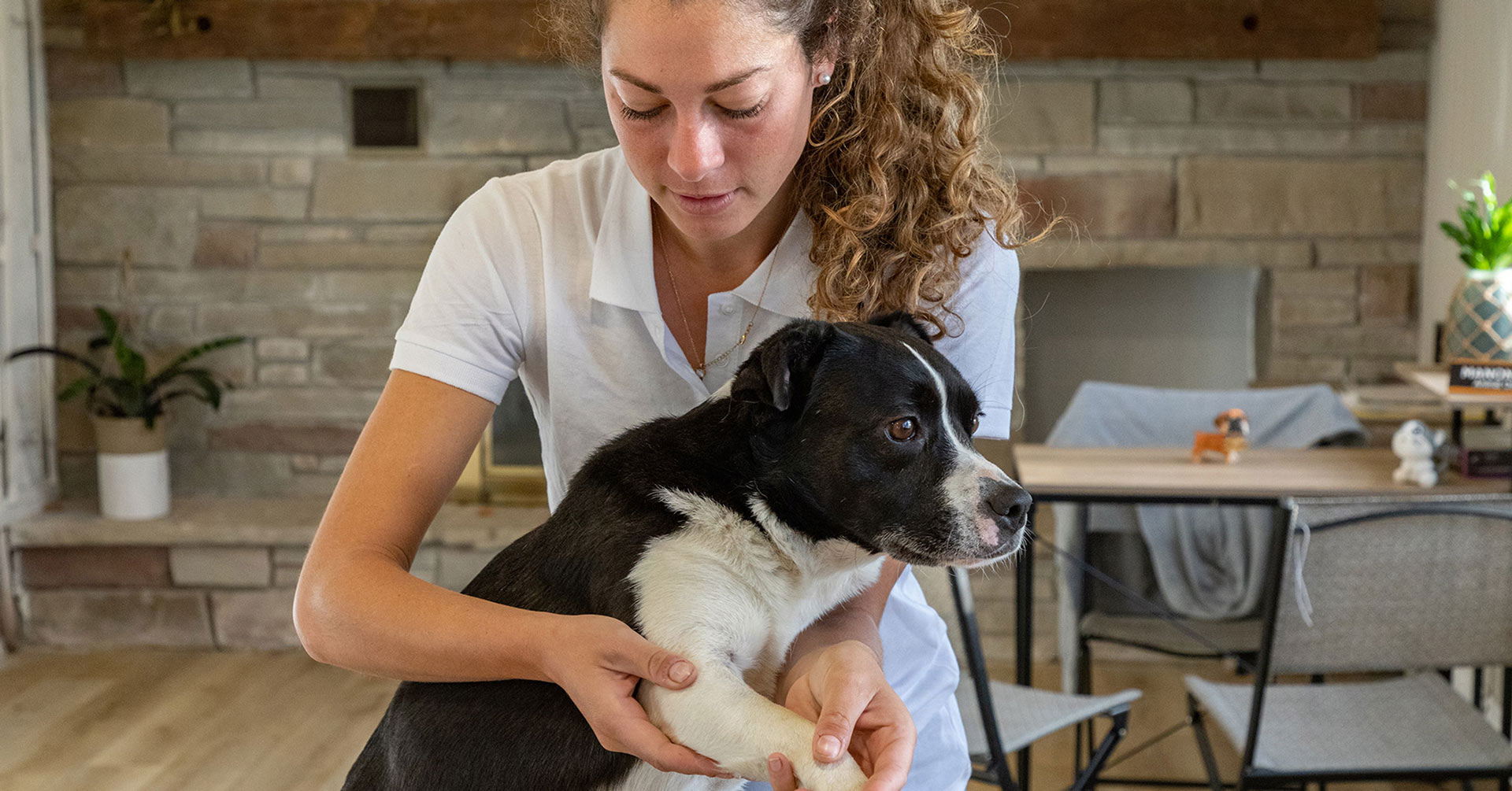
Dog Osteopath in Ontario: How Canine Osteopathy Helps Your Dog
Is your dog showing worrying symptoms? Limping, mood or behavioural changes, sudden exhaustion, bowel issues… I’m Manon, and I’m an animal osteopath. I’m here to help your four-legged friend feel on top form by using a holistic approach.
When should you see a canine osteopath?
See a canine osteopath as soon as your dog changes the way it moves, behaves, eats, or grooms itself. Age has nothing to do with it. A two-year-old agility dog and a twelve-year-old Labrador can both need the same care.
There’s a common belief that only older dogs need an osteopath. That’s not true. Here are five signs worth watching.
Moving Around
There are several reasons why a dog may have trouble moving. Canine osteoarthritis is one of them, and it affects the cartilage that cushions the joints. Once that cushion wears down, bones rub against each other and every step hurts. Canine osteopathy works on the joints and the muscles around them to soothe that pain and restore a more natural gait. A dog that used to jump into the car without hesitation and now waits at the door is showing exactly this kind of change.
Behaviour
Sudden, unexpected changes in behaviour could mean that your dog is in pain. As well as helping with pain, osteopathy can also reduce any stress your animal is feeling. Dogs don’t complain the way people do. A dog in pain often becomes withdrawn, snaps when touched in a specific spot, or loses interest in play. A dog that starts guarding its food bowl or growls when picked up is often reacting to pain, not becoming aggressive by nature. Osteopathy treats the physical cause of that stress, not just the symptom. Reducing tension along the spine, for instance, can calm a dog that has become unusually reactive around its hindquarters.
Digestive Problems
Osteopathy involves specific manual movements that can improve different digestive issues: vomiting, diarrhoea, constipation. The vagus nerve, which runs from the base of the skull down through the diaphragm, plays a direct role in digestion. Tension around the neck or ribcage can affect that nerve and slow digestion down. Gentle manipulation in that area often brings visible relief within a day or two.
Growth
This relates more to puppies that present stunted growth. The osteopath will realign problem joints while also relieving tension that can prevent normal growth. A puppy’s growth plates, the soft areas at the end of each bone, stay open for months: around 6 to 8 months in small breeds, and up to 14 to 18 months in large breeds. Any restriction during that window can affect how a limb develops, which is why early sessions matter for growing dogs. Puppies of working breeds, such as Border Collies or German Shepherds, are often the ones brought in during this window, usually because an owner notices one leg developing slightly differently from the other.
Skin Problems
Animal osteopathy is useful for pets that over-groom or suffer from allergies, excessive moulting and skin problems. Over-grooming is often a response to referred pain: a dog will lick or chew a paw or flank because a nerve or a joint nearby is irritated, not because the skin itself is the real problem. Treating the underlying restriction usually reduces the licking within a few sessions.
How can you book an appointment with Manon Turbe, an expert canine osteopath?
I’m Manon Turbe and my love of animals led me to forge a career where I can help your pets live life to the fullest. I cover the whole of Ontario. My clinic is in Campbellville, but I can travel all over the region. I can travel even further if I have a certain number of animals to treat during my rounds. Please check out my canine osteopathy price list to find out more. I work with all dog breeds and can treat working, housebound, sports and domestic guard dogs. I’m also a cat and horse osteopath. Please feel free to get in touch if you have any questions about my services – you can contact me via my website, WhatsApp, Facebook and Instagram. I’ll happily answer any queries you have.
Is your dog showing worrying symptoms? Limping, mood or behavioural changes, sudden exhaustion, bowel issues… I’m Manon, and I’m an animal osteopath. I’m here to help your four-legged friend feel on top form by using a holistic approach.
Where do I practice?
I practice in all Ontario. I am based in Waterdown, so I am practicing in nearby towns within a maximum of 1 hour drive regularly. (Puslinch, Milton, Campbellville, Brampton, Toronto, Kitchener, Guelph, Cambridge, Burlington, Hamilton).
I opened my own Clinic since August 2023, located at 695 Middletown Road, Waterdown, L8B1P7. I welcome small & medium animals (dogs and cats).
For further trips it will be by rounds with a minimum of animals required.
Regarding Northern Ontario, more specifically in the areas of Muskoka, Parry Sound, Nipissing, West Nipissing, Sudbury, Algoma and Renfrew County, Ottawa, I advise you to contact my partner Breanna Pearce directly.
I practice in the Caribbean on tours, mainly in the islands of Saint-Barthélémy and Sint-Maarten. I generally organize 4 to 5 rounds in the year or more depending on the needs of the animals. In Saint-Barthélémy I work at Clinique vétérinaire Centre de l’Oasis and at Clinique vétérinaire de Grand Case at Saint-Martin.
What Happens During a Canine Osteopathy Session?
A canine osteopathy session lasts between 30 and 45 minutes and follows three steps: a health history review, a hands-on assessment, and gentle manipulation. Nothing about it is invasive.
Before the Session
Manon starts by asking about your dog’s history: past injuries, surgeries, activity level, and any recent change in behaviour. This conversation shapes the whole session, because a working dog and a senior lapdog need different approaches.
During the Session
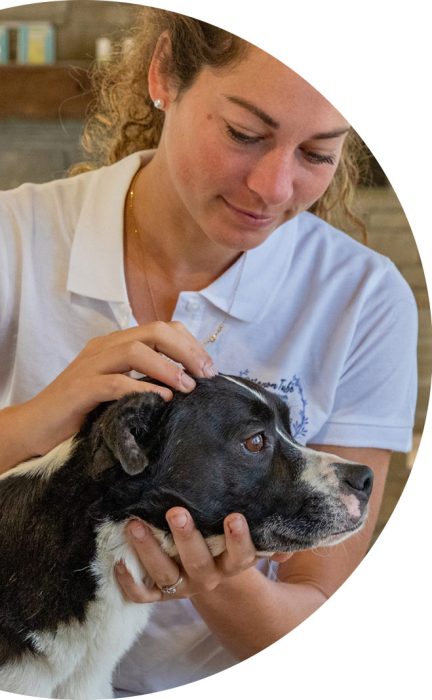
The assessment comes next. Manon checks how your dog stands, walks, and moves each joint, looking for restrictions in the spine, pelvis, and limbs. Treatment itself uses light pressure and slow, targeted movements, never sudden force. Most dogs relax within the first few minutes, and some fall asleep on the table.
After the Session
Expect your dog to be a little tired for 24 to 48 hours. That’s a normal sign the body is adjusting, not a reason for concern. Rest during that window helps the effects of the session settle in. A follow-up plan, if needed, depends on your dog’s condition and how they respond to the first visit.
Which Conditions Can Canine Osteopathy Support?
Canine osteopathy supports dogs with osteoarthritis, hip dysplasia, back pain, post-surgical stiffness, and growing pains in puppies. It works alongside veterinary treatment, not instead of it.
- Osteoarthritis and joint stiffness, especially in senior dogs
- Hip and elbow dysplasia, common in larger breeds like Labradors and German Shepherds
- Recovery after orthopaedic surgery, such as cruciate ligament repair
- Growing pains and postural issues in puppies under 18 months
- Performance strain in agility, herding, and working dogs
Osteopathy is a complement to veterinary care, not a substitute for it. Manon works alongside your vet, never in place of one.
Prices

dog
60 €
90.40 CAD

cat
60 €
90.40 CAD

horse
100 €
146.90 CAD
- Prices vary depending on the species of animals and their location (HST are included).
- Travel costs to be expected.
- Possibility of making preferential rates for professionals with several animals to follow.
- For animal protection associations or shelters, prices are halved.
Contact / Book
How often should a dog see an osteopath?
Most dogs benefit from two to four sessions a year. Working and agility dogs often need more frequent visits, while a healthy adult dog may only need one check-up annually.
Can osteopathy replace a visit to the vet?
No. Osteopathy complements veterinary medicine, it doesn’t replace it. Always keep your vet informed, especially if your dog is on medication or recovering from surgery.
At what age can a puppy see an osteopath?
Puppies can be seen from a few weeks old, particularly to check for asymmetries linked to birth position or early growth. Sessions are adapted to a puppy’s smaller, more delicate frame.
